Seeing and Being Seen: Identity Negotiation in Everyday Conversations

10:15 AM – 11:00 AM, PODCAST presentation
About the topic
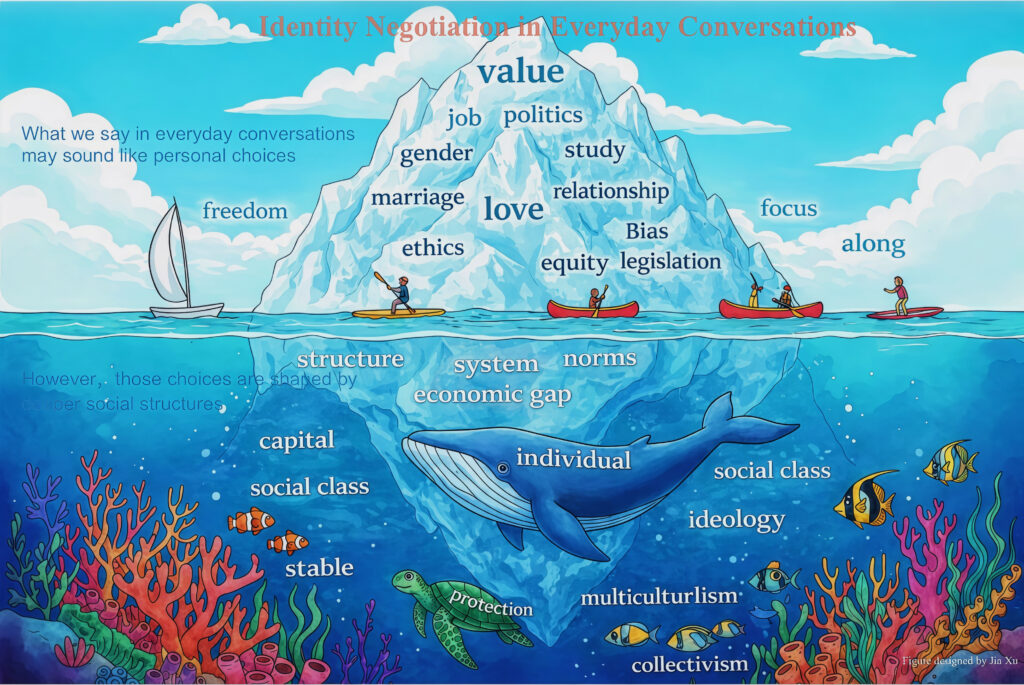
My project explores how people negotiate their identities in everyday conversations. Through simple interactions, such as talking about future plans or life choices, individuals express and reshape who they are. I focus on how these moments reflect deeper cultural values, personal expectations, and social structures that are often not immediately visible.
The Paper
This research is inspired by a conversation between myself and a Thai classmate about our future careers. While I emphasized stability, shaped by family expectations and responsibilities, my classmate focused on pursuing his dream of opening a restaurant. Through this interaction, I identified three key concepts: Stable, Dream, and Risk. These words reflect how individuals from different cultural and social backgrounds negotiate their identities in conversation. Rather than treating identity as fixed, this project understands identity as something that is continuously shaped through interaction. By examining everyday conversations, this research reveals how personal choices are influenced not only by culture, but also by broader social structures such as class, expectations, and migration experiences.
Relevant implications
This project highlights how everyday conversations can reveal deeper social and cultural dynamics. It encourages people to reflect on how their own choices are shaped by both personal values and social contexts. In a multicultural society like Canada, understanding identity negotiation can help build more empathetic and meaningful communication across differences.
Click the link icon to listen to the talk
Biography & Interests
Jia Xu
Jia is an international student from China who often gets caught up in small, easily overlooked details of everyday life. She tends to think about the “inside” and “outside” of things—what shows on the surface, and what stays hidden underneath. For her, thinking is less like a task and more like a habit. Without it, life starts to feel a bit passive, like moving through things without really noticing them. While some people explore the world by going far away, she finds that exploration can also happen in quiet moments—even in wondering how something ordinary might see or experience the world differently. Lately, she has been thinking about how she makes meaning of familiar ideas, like the iceberg model, and how these ideas slowly become personal through her own experiences and conversations.