
Communication Challenges in Classroom Participation: International Students in Canadian Universities

About the topic
This research examines how classroom participation in Canadian universities is shaped by cultural expectations rather than being a neutral measure of student engagement. Focusing on international students’ experiences, it reveals that participation isn’t simply about speaking. Rather, it reflects deeper issues of identity, confidence, and belonging. The study highlights how everyday classroom interactions turn into complex settings where students navigate language, cultural norms, and academic expectations.
The Paper
This paper critically explores the communication challenges international students face in participation-based classrooms. Drawing on identity negotiation theory and non-Western perspectives on communication, it argues that commonly valued practices—such as directness, spontaneity, and verbal assertiveness—are culturally specific rather than universal. Analyzing classroom examples, the paper reveals how factors such as processing time, fear of negative evaluation, accent awareness, and varying cultural interaction styles shape how students participate. This challenges the idea that silence means disengagement. Instead, it suggests silence can be a meaningful, strategic response in intercultural settings.
Relevant implications
This research suggests a fresh perspective on how we understand and evaluate participation in higher education. It suggests that current practices may unintentionally privilege certain cultural communication styles while marginalizing others. By recognizing participation as culturally constructed, educators can develop more inclusive approaches that value different forms of engagement, ultimately supporting equity, confidence, and belonging among international students.
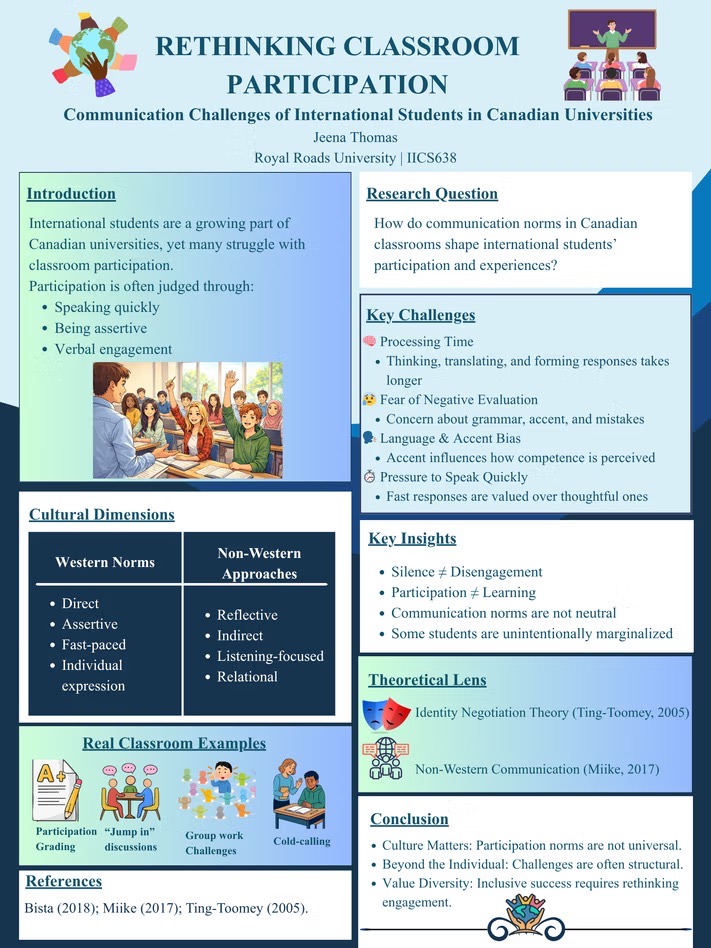
Check out her poster
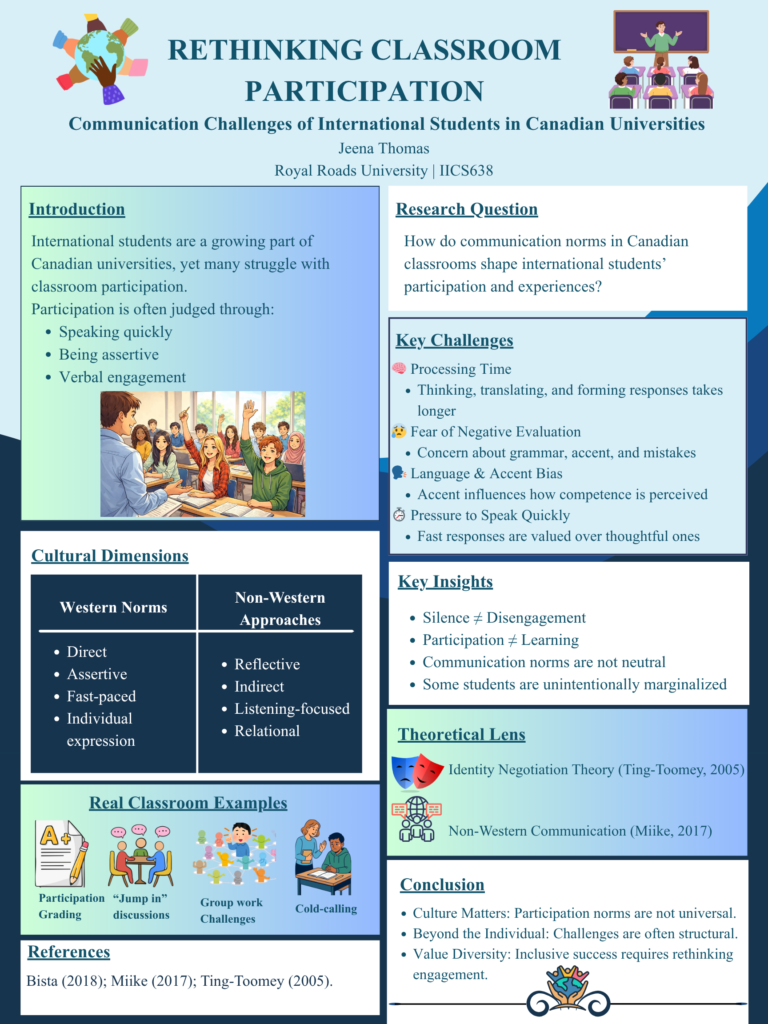
Click the link icon to learn more
Biography & Interests
Jeena Thomas
Jeena Thomas is a graduate student in the Master of Arts in Intercultural and International Communication program at Royal Roads University. Her research focuses on intercultural communication in educational settings, with particular attention to student participation, identity, and inclusion. She is interested in exploring how communication practices shape learning experiences and how more equitable academic environments can be created for diverse student populations.