Module 1 – What is Participatory Research
What is Youth Participatory Action Research?
Children and young people have fundamental rights, including the right to participate in decisions that impact them. Youth participatory action research (YPAR) provides a platform to bring this right into a reality.
What is YPAR? Let’s break it down.
Youth– it is led by youth. There are often adults involved, but their role should be as supporters of young people. Youth are not always listened to as much or as fully as they should be. YPAR honours the important voice and opinions of young people.
Participatory – Processes should involve the community, however you define community. This may include people in your neighbourhood or in your social media group or in your school. In a participatory process, decisions about what to ask, how to ask it, who should be involved, and how to understand what has been collected are made together. While there will likely be a lead, the members of the community are important contributors and together the ‘community’ is more than the individual members of the group. There are many kinds of participation and not all participatory processes are respectful or beneficial, so it is important to get this right.
Roger Hart (1982) talks about the ladder of child and youth participation, with the worst kinds of participation including manipulation, decoration, and tokenism which includes little participation, but the more actual participation is provided the more beneficial the process can be. This process aims to focus on the highest level of participation as imagined by Roger Hart in 1992:
- Child-Initiated & Led, Shared Decision-Making
- Child-Initiated & Led
- Adult-Initiated, Shared Decision-Making
- Consulted & Informed
- Assigned but Informed
- Tokenism
- Decoration
- Manipulation
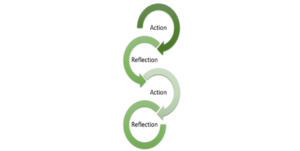
Action- Action illustrates the importance of using research to learn about an issue for the purpose of taking action to make something better. Action research generally involves cycles of reflecting and acting, reflecting and acting to support collaborative work towards social change.
Research- Research is simply a process that acts on curiosity. It allows researchers to ask questions about their world and find ways to systematically answer them.

Why conduct YPAR?
YPAR is one way young people seek to co-create change in the world. It provides a way that young people can understand the world around them and gather stories from people in their community. Through this process, they can begin to change stories around them and work towards the kind of change they wish to see in the world.
Like a forest ecosystem, everyone in a system brings their unique gifts to a space. YPAR respects their unique ideas, stories, and opinions.
We believe that in looking at ways to foster a more respectful way to honour the environment and the home it provides for us. This can best be supported by bringing in a range of voices from our community about how to do this.
Video
Please see here for an introductory video that highlights the basic principles of youth participatory action research and the importance of youth voice. This is presented by youth climate activists Sam Lin and Rebecca Hamilton, as well as Rebeccah Nelems.
How can we practice?
Check out the Phoenix Consultation
The Phoenix Consultation was a group of youth and adult allies who will be coming together from across North America to discuss their experience of environmental rights. The main consultation was from July 15-18th, 2021 and led to a framework for action. Check out the website- https://www.childrenvironment.org/north-america-consultation
Where can we find out more?
If you would like to learn more about YPAR there are many resources available online covering different contexts. Here are a few to look up:
- Save the Children (2018). Participatory Action Research – A ‘how to’ guide for use with adolescents in humanitarian contexts. https://resourcecentre.savethechildren.net/document/youth-voices-participatory-action-research-adolescents-affected-syria-crisis-egypt-and
- YUC Berkley (2025). Why YPAR?. https://yparhub.berkeley.edu/why-ypar