Module 6 – Participatory Methodologies, Methods, and Project Design
Gathering Data – Choosing your Methodology, Methods and Project Design
Your research question is about what you and your research participants want to know. Once you have set your question you can begin to plan how you will answer the question with your community.
Methodology
Research methodologies refer to how you will conduct your research. There are lots of different kinds of research methodologies. Each one sets out the pathway for conducting your research. YPAR is a methodology and while there are different ways to conduct YPAR, the basic principles include youth working collaboratively with a community to research an issue with a view to making change through cycles of action and reflection.
Participants and Participation
In YPAR your participants and your team are critical. They will be involved in each step of your research. Your participants will be drawn from your community however you define this. One way to understand the most relevant participants to involve is to consider a child rights ecology (drawn from IICRD, see below). This helps to identify the different people involved in a child or young person’s life. In this framework the child or young person in the center, surrounded by circles or ripples, with the family, community, environment, civil society, government and non-government organizations, and more generally cultural, social, spiritual, political, or economic systems on the outside of the circle. Core children’s rights of participation, protection, survival, and development support the whole system.
Reflection
Within this ecology, consider which groups of people are most helpful in answering your question or what groups of people are most important to work with to ask the right questions.
CHILD RIGHTS ECOLOGY
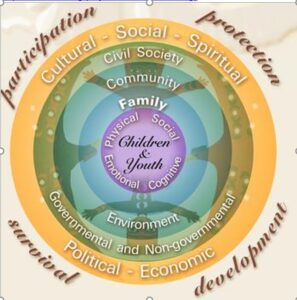
https://www.iicrd.org/projects/child-rights-ecology
Methods
Methods refer to the way you will collect data or information. There are many kinds of research methods. Because you are using a participatory action research methodology, you will be using participatory engagement methods. There are four basic types of participatory methods:
- Small group methods
- Arts-based methods
- Individual methods
- Large group methods
Some examples of arts-based methods include:
- Metissage
- Photo Voice
- Participatory Video
- Draw & Tell/Write
Individual methods are common. Some examples of individual methods include:
- Survey
- Interviews
Examples of large group methods include:
- Open Space
- World Cafe
- Liberating Structures
Examples of small group methods include:
- Talking Circle
- Focus Group
- Storytelling
Designing your Project
In setting out a research project, even a simple one, there are several steps involved. Remember in YPAR you are co-creating change. Some steps to consider include:
- What is the bigger CHANGE that you and your participants hope to influence? (Vision)
- What is the FOCUS of your project? (Research Question)
- What are the STEPS you need to take? (Research Plan)
- WHO is part of your project? (Participants)
- HOW do they want to be engaged? (Methods)
- What ETHICAL considerations do you want to consider? (Ethics)
- What is the sequence of events and WHEN? (Timeline)
Video
In this video, Rebeccah, Catherine, and Kathleen provide a brief overview of participatory methodologies, methods, and project designs.
Where can we find out more?
There are a range of sites and resources you can draw on for each of the individual methods. To explore a bit more about methods in one place, check out this YPAR dedicated space:
YPAR Hub (2021). Investigate. https://yparhub.berkeley.edu/investigating-problem