Module 7 – Participatory Data Analysis and Associated Knowledge Products
What is data?
Data is information. It is what you collect from participants. It can include their ideas, stories, images, and perspectives. Data is everywhere. Examples of data include:
- Audio / video recordings
- Story transcripts
- Interview/focus group transcripts
- Survey responses
- Drawings / Images
- Photographs
- Sculptures/Art forms
- Text from documents
- Observational notes / field notes
- Flipchart (in person or virtual) notes/materials
- Physical artifacts
- Researcher journal notes
What is data analysis?
Data analysis is the process of making meaning out of different pieces of data. We do it all the time. During the research, we chose a process for systematically reviewing, sorting, synthesizing, and summarizing data.
Meaning Making
In order to begin data analysis and make meaning out of what you see before you, practice the following:
- Notice what you Notice: How do your assumptions, biases, beliefs, worldviews, stories, and experiences affect what you notice?
- Practice Deep Listening: Listen to understand, not to respond
- Ensure Diversity of Participants: Diversity is a resource
- Bring Participants into the Data Analysis process: This is critical to a YPAR approach
- Honour Participants’ Stories: Participants are the best experts on their experiences and perspectives
- Be Curious and Open: Curiosity before judgment
Sorting and theming
In order to make meaning, we start by sorting data. Once sorted, you can bring pieces together in codes, from codes you can create categories or themes. With these themes, you can begin to make sense and meaning of your data.
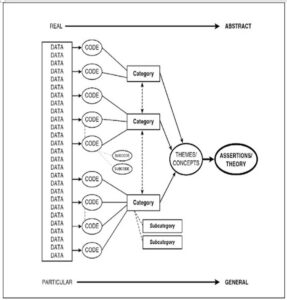
(source: Saldana, 2016, p. 14)
Video
Join Catherine, Rebeccah, and Kathleen to explore how to analyse and communicate your research.
What are the key concepts?
“There is an expression: ‘If I hadn’t seen it with my own eyes, I wouldn’t have believed it.’ The opposite holds just as true: ‘If I hadn’t believed it, I wouldn’t have seen it” (Shawn Wilson, 2008).
How can we practice?
In order to understand the way we take in, sort, exclude information in different ways, try these exercises:
Where can we find out more?
If you want to know more about Data Analysis, here are some resources to look out for:
Linda Liebenberg, Aliya Jamal, & Janice Ikeda. (2015) Spaces and Places Data Analysis. Analysing data with youth: A guide to conducting thematic analysis. https://youthspacesandplaces.org/wp-content/uploads/2015/09/Spaces-and-Places-Data-Analysis-Manual.pdf